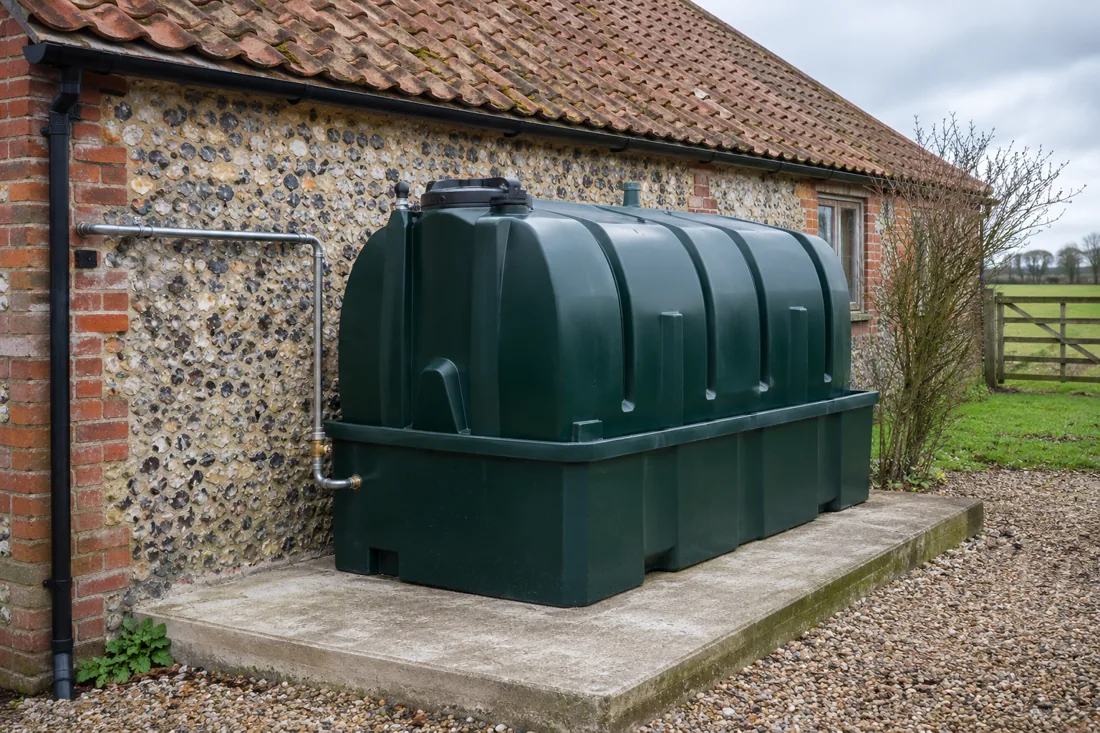
When Replacement Makes Sense
Cracking plastic, deformation, weeping seams and deteriorating supports are reasons to get an oil tank assessed. They do not establish the cause on their own. An unreliable gauge, damaged fitting or blocked fuel line may call for a different repair rather than a complete new tank.
Replacement is also worth considering when fuel demand changes or an extension leaves the existing position unsuitable. Our Lincolnshire enquiries cover oil-heated homes, farmhouses and commercial storage. If oil is escaping now, follow the leaking tank guidance before starting a routine quotation request.
Retain The Position Or Start Again?
A like-for-like footprint is not proof that the old base and position are suitable. Support requirements, nearby buildings, boundaries and pollution risks need checking against the proposed installation. A new tank must be selected as part of a complete system.
If the existing position is suitable, retaining it can limit pipework and ground works. A move may improve delivery access or release space, but can add a base, a longer fuel line and protection against damage. Compare both scopes before choosing simply on tank dimensions.
Select Capacity And Construction
Use actual consumption and delivery arrangements to discuss capacity. A larger tank needs more space and support, while an awkwardly small store can limit ordering choices. Send the old tank label if it is readable from a safe position.
Plastic and steel tanks suit different layouts and uses. A bunded design provides an outer containment space, but the outer shell also changes the overall footprint. Horizontal, vertical and slimline shapes should be assessed for installation access as well as where they will finally stand.
For a farm, describe what each tank feeds. Domestic heating and agricultural fuel storage are not interchangeable categories under the guidance.
Plan The Changeover And Remaining Fuel
The installer agrees how the connected heating or equipment will be taken out of service, how oil will be recovered and how the old tank will be removed. Usable fuel may be transferred after its condition is checked. Contaminated fuel should not simply be returned to a new installation.
Heating is interrupted while connections are changed and checked. A temporary supply can be discussed for longer programmes, subject to suitability, availability and extra cost. Tell us about vulnerable occupants, occupied rental properties or business equipment that cannot tolerate an unplanned interruption.
Base, Pipework And Compliance
A replacement needs a stable, level support arrangement matched to the manufacturer’s requirements. An old slab may be cracked, undersized or unsuitable for a different tank shape. New concrete work also affects the programme because the base needs to be ready before loading.
Domestic installation work is considered under Building Regulations, with Approved Document J providing relevant fuel storage guidance in England. Discuss fire protection and pollution containment with the installer rather than working from a single generic separation distance.
Confirm the compliance route before booking, including competent person notification or Building Control involvement where appropriate. This site makes no claim to OFTEC registration.
Photos That Make A Quote More Useful
Send a broad view of the tank, a view of the base, the nearby building and boundary, and the route from the road. Add the postcode, fuel level and any known access width. Please take photographs from accessible ground rather than climbing behind or over equipment.
On farms and commercial sites, identify buried lines, overhead cables and the preferred delivery entrance. Long drives, weight restrictions and soft verges influence vehicle selection. Mention any extension or landscaping plans so the new installation is not obstructed shortly afterwards.
Compare The Scope And Handover
A replacement quote should distinguish tank supply, old tank removal, liquid handling, base works, pipework and commissioning. Tank specification, difficult access, temporary storage and waste quantities all affect cost. Ask what happens if inspection reveals unexpected damage or contamination.
At handover, request product information, warranty terms and a record of checks. Agree which installation and compliance documents apply, plus waste records for removed material. Keep these together and ask the installer to explain the fill point, gauge and routine visual checks.
Common Questions
Can I Keep My Remaining Heating Oil?
Remaining heating oil may be kept if assessment shows it is suitable for reuse and compatible storage is available during the changeover. Water or sludge needs separating from usable fuel. Ask the quotation to explain transfer, temporary holding and disposal, including what happens if the recovered oil is unsuitable.
Will A Replacement Fit My Existing Base?
A replacement oil tank may fit an existing base, but dimensions alone are not enough. Its load, support requirements and the condition of the slab need checking. The installer should also review the surrounding position, pipework and containment requirements before agreeing that the base can be reused.
Tell us what you have and what needs to change.
Request a quote